ASSP route · Final task and testParcours ASSP · Tâche finale et test
Final task · A home visit in Poplar, then and now
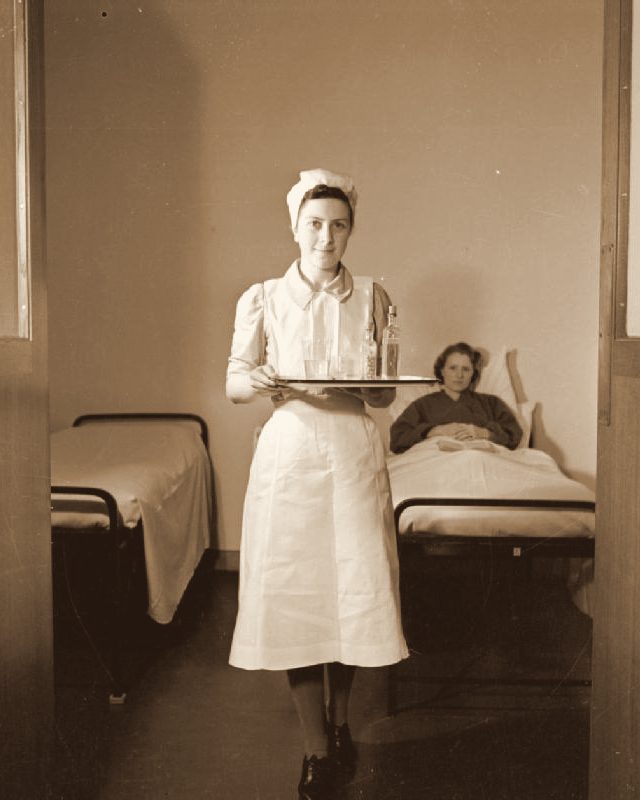
You are a care student on placement with a home help service. With a partner, you play a home visit to an elderly person or to a young mother (choose the year: 1960 in Poplar, or today in France). During the visit, a small emergency happens (a fall, a burn, a person who feels faint). Then you write the visit report for the team.
Part 1 · The visit (oral, in pairs)Partie 1 · La visite (oral, en binôme)
- Arrive, introduce yourself and ask permission (can, could, may).
- Do one care gesture and explain why (so that, to).
- Give two pieces of advice (should, shouldn’t).
- React to the emergency with clear steps and rules (must, mustn’t, first, then).
- Talk to the worried person honestly (may, might) and make an offer (Would you like…?).
- Remind one rule of the job (be allowed to) and say goodbye.
Sentence startersDébuts de phrases
- Good morning, I’m… from… May I come in?
- Could you…, please? I’m going to… so that…
- You should… You shouldn’t…
- Don’t move! First, … Then, … You mustn’t…
- It might… Would you like me to…?
- I’m not allowed to… but I can… See you on…
Part 2 · The visit report (written)Partie 2 · Le compte rendu de visite (écrit)
- Date, time, place, name of the person (invented).
- What you did (past simple) and what was happening when the emergency started (past continuous).
- The first aid steps, in order.
- How the person and the family feel; what is possible (may, might).
- Two pieces of advice for the team and the family.
Sentence startersDébuts de phrases
- Visit report · On … at …, I visited…
- I helped her to… While she was…, she…
- First, I… Then, I… Finally, I…
- She was… The doctor may…
- The family should… We must…
Three levelsTrois niveaux
- Entry · A2: oral in three minutes with the starters; report of 50 words, you may use your vocabulary notebook.
- Core · B1: oral in four minutes without reading; report of 100 words.
- Going further · B2: oral in five minutes, with one change of register (oral to the patient, formal to the doctor on the phone); report of 150 words in formal English, with two modals in the past and a final paragraph comparing care in 1960 and today.
How will I be assessed? Grid out of twentyComment serai-je évalué(e) ? Grille sur vingt
| Criterion | Points |
|---|---|
| Task and situation The visit is complete: arrival, care, advice, emergency, end. Then and now is clear. | / 4 |
| First aid The steps are in the right order and safe (check, protect, alert, gesture, stay). | / 4 |
| Accompaniment and ethics Consent, privacy, dignity, honesty, listening, professional limits. | / 4 |
| Language: modals and tenses can / could / may, must / mustn’t, should, might, be allowed to; past simple and continuous in the report. | / 4 |
| Vocabulary, pronunciation, fluency Care and first aid words, clear stress, the partner understands; the report is readable. | / 4 |
| Total | / 20 |
Show a model visit (oral)Voir un modèle de visite (oral)
Carer: Good morning, Mrs Hall. I’m Inès, a student from the home help service. May I come in? … Could you sit down here, please? I’m going to help you with your stockings, so that your legs are less swollen.
Mrs Hall: My daughter says I drink too much tea.
Carer: You should drink water too, and you shouldn’t carry the kettle when it’s full. … (Mrs Hall stands up quickly and falls back on the sofa, pale.) Mrs Hall! Don’t move. First, lie back. Then, I’m raising your legs on this cushion. You mustn’t get up quickly. Can you hear me? Good. You’re breathing well.
Daughter (arriving): What happened? Is it her heart?
Carer: I don’t know. It might be her blood pressure. The doctor may come this afternoon; I’m going to call the office. Would you like me to stay until she feels better?
Carer: I’m not allowed to give her medicine, but I can stay with her and write everything in the notes. I’ll come back on Thursday.
Show a model report (written)Voir un modèle de compte rendu (écrit)
Visit report · Monday 2 November, 10 a.m., Mrs Hall’s flat (invented name).
I helped Mrs Hall to put on her stockings. While she was standing up to make tea, she felt dizzy and fell back on the sofa. She was pale but she was breathing and she answered. First, I made her lie back. Then, I raised her legs. Finally, I called the office, and I stayed with her for twenty minutes. She felt better and she drank a glass of water. Her daughter was worried: it might be her blood pressure, and the doctor may come this afternoon. Advice: the family should keep a chair near the kitchen, and Mrs Hall shouldn’t stand up quickly. We must check her blood pressure on Thursday.
TestTest / 20
Part A · Vocabulary (6 points)
- Give the English: une plaie · une brûlure · le consentement · une couche · une canne · la position latérale de sécurité
- Odd one out, and why: dizzy · pale · sweaty · towel
- Complete: “Test the water with your ______.” “Hand washing kills ______.”
- Give two words of comfort a carer can say to a family.
Show the answer key
- a wound · a burn · consent · a nappy · a walking stick · the recovery position (1 point for each pair of correct words, 3 points)
- towel: the others are signs of shock (1 point)
- elbow, germs (1 point)
- Examples: It isn’t your fault. I’m here. You can cry. (1 point)
Part B · Grammar (8 points)
- Polite request: ______ you lie on your side, please?
- Forbidden: You ______ put ice on a burn.
- Not necessary: You ______ be a doctor to do CPR.
- Advice: You ______ open the window every morning.
- Future ability: He ______ walk at about one year.
- Possibility: The doctor ______ have more answers.
- Rule: Students ______ take photos of residents.
- Tenses: She ______ (walk) to the kitchen when she ______ (fall).
Show the answer key
- Could (1)
- mustn’t (1)
- don’t have to (1)
- should (1)
- will be able to (1)
- may / might (1)
- aren’t allowed to (1)
- was walking, fell (1)
Part C · First aid (3 points)
- Put in order: call 15 · check breathing · recovery position · check danger · check response
- What do you do for a burn?
Show the answer key
- check danger, check response, check breathing, recovery position, call 15 (2)
- Cool it under cool running water for twenty minutes; no ice, butter or cream (1)
Part D · Writing (3 points)
- In five sentences, explain to a new student how to help an elderly person get up after a fall. Use first, then, finally and one modal.
Show the answer key
- Example: First, you mustn’t lift her quickly: check if she is hurt. Then, help her roll on her side. Next, she can get on her hands and knees. Finally, she puts her hands on a strong chair and gets up slowly. You should stay with her and tell the team. (content 1, order 1, language 1)
Homework
Before the final task Entry · A2
Learn the words of the six sessions and prepare your role card: who you are, the year, the person you visit, the emergency.
After the final task Core · B1
Write three sentences about what you learnt for your placement, with should, must and be allowed to.