ASSP route · Session 1 of 6Parcours ASSP · Séance 1 sur 6
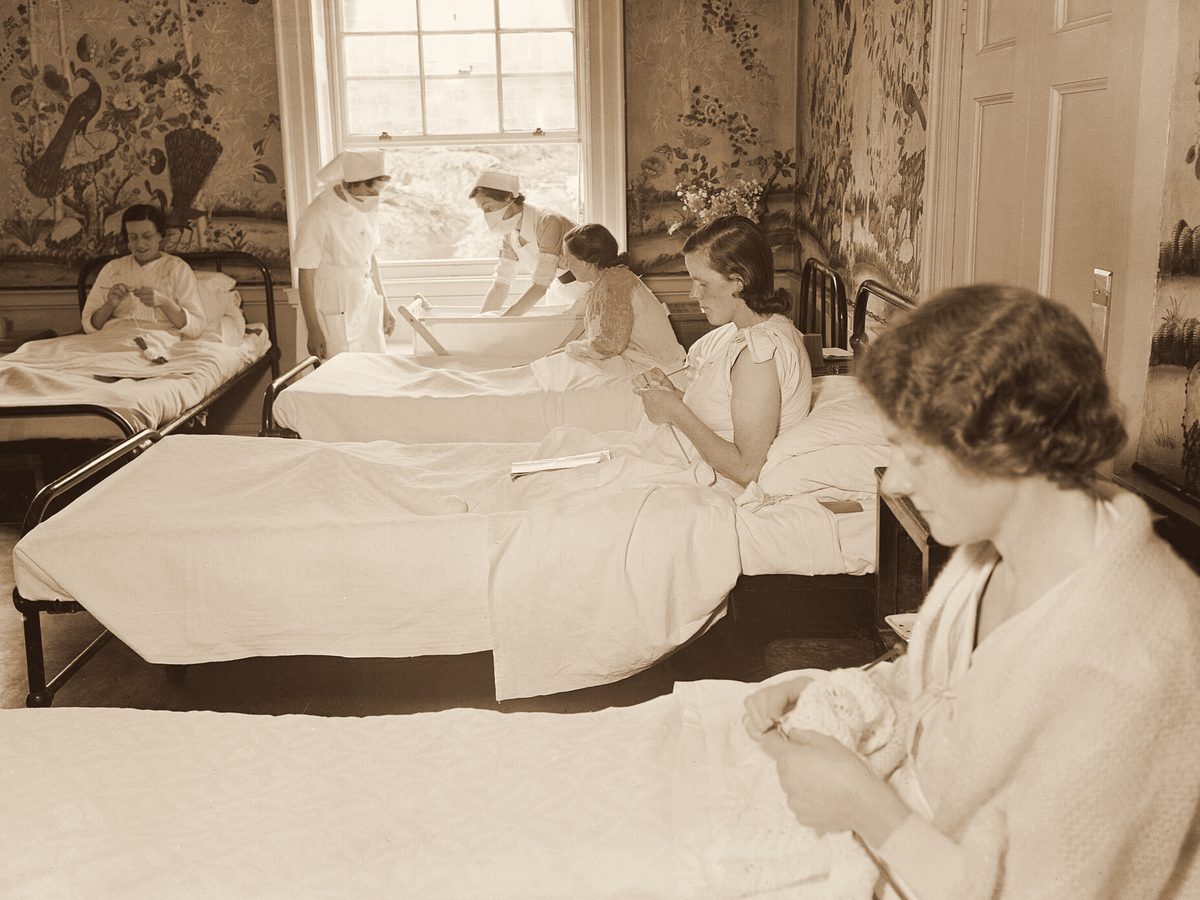
An antenatal visit: “May I check your blood pressure?”Une visite prénatale : « Puis-je prendre votre tension ? »
Poplar, 1960. The district midwife visits a mother-to-be at home. Before she touches the patient, she asks. Today, on placement in a maternity ward, a PMI centre or a crèche, you ask too.Poplar, 1960. La sage-femme du quartier rend visite à une future maman chez elle. Avant de la toucher, elle demande. Aujourd’hui, en PFMP en maternité, en PMI ou en crèche, vous demandez aussi.
Modal focus: can, could, may: asking, offering, permission
RecapRappel / 4
Answer in your notebook, without looking. Then check and write your mark out of four.Répondez dans le cahier sans regarder. Puis corrigez et notez-vous sur quatre.
- When did the NHS start? 1 pt
- What does a midwife do? 1 pt
- Where is Poplar? 1 pt
- Name two of the “five giants” of the Beveridge Report (1942). 1 pt
Show the answers
- On 5 July 1948.
- She looks after women during pregnancy and birth, and after the birth.
- In the East End of London, next to the docks.
- Want, Disease, Ignorance, Squalor, Idleness: any two.
Entry versionVersion d’entrée Entry · A2
- The NHS started in: a) 1918 b) 1948 c) 1968
- A midwife helps: a) mothers and babies b) dockers c) teachers
Show the answers
- b) 1948
- a) mothers and babies
What we need to sayCe que nous avons besoin de dire
In this session, we want to ask a patient before we touch her, say what we are going to do and reassure her. If she feels unwell, we want to give a first safety instruction.
To ask, to offer and to ask permission, English uses three small verbs: can, could, may. They come before the verb: May I check your blood pressure?
DocumentsDocuments
Document A · The clip
Watch the BBC extract once without writing, then a second time with the questions. Look at the hands, the faces and the room.
BBC Patsy examines expectant mother Penny (BBC clip)
Short public extract, not a full episode.
Document B · A visit in Poplar, 1960 (dialogue written for this lesson)
Midwife: Good morning, Mrs Walsh. I’m Nurse Clarke, the district midwife. May I come in?
Mrs Walsh: Of course, Nurse. Come in.
Midwife: How are you feeling today?
Mrs Walsh: Tired. And my ankles are swollen.
Midwife: I see. Could you sit down here, please? I’d like to check your blood pressure. May I take your arm?
Mrs Walsh: Yes, go ahead.
Midwife: Thank you. Your blood pressure is normal. Now, could you lie down on the bed? I can listen to the baby’s heartbeat with my trumpet.
Mrs Walsh: Will it hurt?
Midwife: No, it won’t. You can tell me to stop at any time. … The heartbeat is strong. Your baby is fine.
Mrs Walsh: I sometimes feel dizzy when I stand up.
Midwife: Then stand up slowly. If you feel faint, sit down at once or lie on your left side. Can your husband stay with you in the evening?
Mrs Walsh: Yes, he can.
Midwife: Good. May I write that in your notes? Your notes stay private.
Mrs Walsh: Yes, of course.
Midwife: I can come back next Tuesday. Could you keep a glass of water near your bed?
The “trumpet” is a Pinard stethoscope, a small wooden or metal tube that midwives still use to hear a baby’s heart.
Understand the documentsComprendre les documents Entry · A2 Core · B1
- Clip: who is the professional, and who is the patient?
- Clip: does the midwife explain or ask before she examines the patient? Note one sentence or one gesture.
- Dialogue: what two problems does Mrs Walsh have?
- Dialogue: what two checks does the midwife do?
- Dialogue: what must Mrs Walsh do if she feels faint?
- Dialogue: find two moments when the midwife asks permission.
- Dialogue: how does the midwife reassure the mother? Quote two sentences.
Show the answers
- The midwife (Patsy) is the professional; the expectant mother (Penny) is the patient.
- Answers depend on what you hear. Accept a question (with can, could or may) or a gesture: she explains, she waits, she smiles, she looks at the patient.
- She is tired, her ankles are swollen, and she sometimes feels dizzy when she stands up.
- She checks her blood pressure and listens to the baby’s heartbeat.
- Sit down at once or lie on her left side.
- “May I come in?”, “May I take your arm?”, “May I write that in your notes?”
- “No, it won’t (hurt).” “You can tell me to stop at any time.” “Your baby is fine.” “Your notes stay private.”
Words to say itLes mots pour le dire
The stressed syllable is in capitals.
First aid
| dizzy DIZ-zy | pris de vertige |
| to faint faint | s’évanouir |
| blood pressure BLUD PRESH-er | la tension |
| a heartbeat HART-beet | un battement de cœur |
| swollen SWOH-len | gonflé |
| to lie on your side lie on your SIDE | s’allonger sur le côté |
| a glass of water | un verre d’eau |
| at once at WUNS | tout de suite |
Accompaniment
| a mother-to-be MUH-ther to BEE | une future maman |
| pregnant PREG-nant | enceinte |
| an antenatal visit an-tee-NAY-tl | une visite prénatale |
| a midwife MID-wife | une sage-femme |
| consent con-SENT | le consentement |
| privacy PRI-va-cy | l’intimité |
| to reassure ree-a-SHOOR | rassurer |
| to listen to LIS-en | écouter |
| the notes | le dossier |
| to examine ig-ZAM-in | examiner |
Vocabulary practiceEntraînement lexical
A. Match the word and its meaning Entry · A2
Write the letter.
- a midwife: a) a woman who will have a baby b) a professional who helps at birth
- dizzy: a) when your head turns b) when you are hungry
- swollen: a) bigger than normal b) smaller than normal
- consent: a) saying yes to care b) saying no to everybody
- privacy: a) being protected from other people’s eyes b) a private school
- to reassure: a) to make someone less afraid b) to make someone pay
- a heartbeat: a) the sound of the heart b) a heavy bag
- to faint: a) to lose consciousness for a short time b) to paint a wall
Show the answers
- b
- a
- a
- a
- a
- a
- a
- a
B. Complete the midwife’s sentences Entry · A2
Use each word once.
blood pressureprivacydizzyheartbeatnotesreassurelieconsent
- Your ______ is normal: 120 over 80.
- I can hear the baby’s ______.
- If you feel ______, sit down.
- You can ______ on your left side.
- I close the curtain to protect your ______.
- I always ask for your ______ before I examine you.
- I write everything in your ______.
- I talk slowly to ______ the patient.
Show the answers
- blood pressure
- heartbeat
- dizzy
- lie
- privacy
- consent
- notes
- reassure
C. Sort the words: first aid or accompaniment? Entry · A2
Make two lists. Some words can go in both: explain why.
- dizzy · consent · to faint · privacy · to reassure · swollen · to listen · lie on your side · a glass of water · the notes
Show the answers
- First aid: dizzy, to faint, swollen, lie on your side, a glass of water. Accompaniment: consent, privacy, to reassure, to listen, the notes. A glass of water or to listen can go in both: we listen to check, and we listen to comfort.
D. Odd one out Core · B1
Find the word that does not belong and say why.
- midwife · nurse · carer · ankle
- dizzy · faint · swollen · consent
- reassure · comfort · listen · bleed
- notes · privacy · consent · heartbeat
- blood pressure · heartbeat · temperature · towel
Show the answers
- ankle: it is a part of the body, the others are people who care.
- consent: it is not a symptom.
- bleed: the others are attitudes of the carer.
- heartbeat: the others are about the patient’s rights.
- towel: it is not something we measure.
E. Verbs that go together Core · B1
Match a verb with a noun group to make a care action. Then say it in a full sentence.
takelisten toask forwrite inclosecheck
- ______ the curtain
- ______ the patient’s consent
- ______ her blood pressure
- ______ the baby’s heartbeat
- ______ the notes
- ______ her temperature
Show the answers
- close
- ask for
- take / check
- listen to
- write in
- take / check
Grammar lessonLeçon de grammaire
Grammar point 1 · can, could, may: asking before we act
Teacher scriptScript de l’enseignante
“Look at the dialogue. Before every gesture, Nurse Clarke asks. Which little words does she use? (May I, Could you, Can.) We need them because a carer never touches a patient without asking. Today we learn how to ask politely, how to offer and how to give permission.” Underline the modals in the dialogue together, then build the board with the class.
On the board · copy in your notebookAu tableau · à recopier
- Rule
- A modal verb adds an attitude to the action: permission, request, offer, ability.
- Form
- subject + modal + verb (no to, no -s) · question: modal + subject + verb? · negative: can’t, couldn’t, may not
- Use
- May I…? = I ask permission (polite). Could you…? = I ask you to do something (polite). Can I…? = I offer or I ask (friendly). You can… = I give permission.
- Examples from the lesson
- May I take your arm?
- Could you lie down on the bed?
- I can come back next Tuesday.
- You can tell me to stop at any time.
- Common mistakes
Can I to check…?→ Can I check…?She cans come.→ She can come.May you sit down?→ Could you sit down?
- French and English
- French: « Puis-je… ? Pourriez-vous… ? » English: no subject and verb inversion with the main verb, the modal goes first: May I…? In French we say « s’il vous plaît » less often with a carer’s request; in English, please is almost compulsory.
Quick check
- Polite request: ______ you open your mouth, please?
- Permission: ______ I sit here?
- Correct it: “Can you to sit down?”
Show the answers
- Could
- May
- Can you sit down?
Grammar point 2 · Word order in questions and prepositions of time
Teacher scriptScript de l’enseignante
“Mrs Walsh needs to know when the midwife comes back and when to drink water. Listen: on Tuesday, in the evening, at once. Three little words for time. Which one goes with a day?”
On the board · copy in your notebookAu tableau · à recopier
- Rule
- Questions with a modal: the modal comes first. Time: on + day or date, in + part of the day, month, year, at + clock time or “at once”.
- Form
- Modal + subject + verb + object + time: Can your husband stay with you in the evening?
- Use
- on Tuesday · on 4 March · in the evening · in 1960 · at ten o’clock · at once (tout de suite)
- Examples from the lesson
- I can come back on Tuesday.
- Can your husband stay with you in the evening?
- If you feel faint, sit down at once.
- Common mistakes
in Tuesday→ on Tuesdayat the evening→ in the eveningYour husband can stay?→ Can your husband stay?
- French and English
- French uses no preposition for days: « Je reviens mardi ». English needs on: I’ll come back on Tuesday.
Quick check
- I come back ______ Friday.
- The clinic opens ______ nine o’clock.
- Put in order: you / could / sit down / please
Show the answers
- on
- at
- Could you sit down, please?
Memo cardFiche mémo
Asking permission (before I do something to you): May I check your blood pressure? (very polite) · Can I take your arm? (friendly)
Asking someone to do something: Could you sit down, please? (polite) · Can you lie on your side?
Offering: Can I help you? · I can come back on Tuesday.
Giving permission: You can tell me to stop at any time.
How it works: modal + verb without to, no -s: She can come (not she cans to come). Question: modal before the subject: May I…? Could you…? Negative: can’t, may not.
Answering: Yes, of course. · Yes, go ahead. · I’d rather not, thank you.
Grammar practice: from recognition to your own sentencesEntraînement : de la reconnaissance à la production
1. Recognise Entry · A2
Find the modal in each sentence from the dialogue. Is it permission, a request or an offer?
- May I come in?
- Could you sit down here, please?
- May I take your arm?
- You can tell me to stop at any time.
- I can come back next Tuesday.
- Could you keep a glass of water near your bed?
Show the answers
- may: permission
- could: request
- may: permission
- can: giving permission
- can: offer
- could: request
2. Transform: make it polite Entry · A2
Change the order into a polite question with could. Add please.
- Sit down.
- Give me your arm.
- Lie on your side.
- Open the window.
- Show me your ankles.
- Stand up slowly.
Show the answers
- Could you sit down, please?
- Could you give me your arm, please?
- Could you lie on your side, please?
- Could you open the window, please?
- Could you show me your ankles, please?
- Could you stand up slowly, please?
3. Transform: ask permission Entry · A2
You want to do something. Ask with May I…?
- take your temperature
- look at your notes
- close the door
- listen to the baby’s heartbeat
- help you to sit up
- call your husband
Show the answers
- May I take your temperature?
- May I look at your notes?
- May I close the door?
- May I listen to the baby’s heartbeat?
- May I help you to sit up?
- May I call your husband?
4. Correct the mistake Core · B1
One mistake in each sentence.
- Can I to check your blood pressure?
- She cans come on Tuesday.
- May you sit down, please?
- I can to help you.
- Could you lying on your side?
Show the answers
- Can I check your blood pressure?
- She can come on Tuesday.
- Could you sit down, please? (we use may for I and we)
- I can help you.
- Could you lie on your side?
5. Guided production Core · B1
What do you say? Use can, could or may.
- You arrive at the door of a patient.
- You want the mother to take off her shoes.
- You offer to bring a glass of water.
- The patient asks if she can stop the exam. You agree.
- You want to write in her notes.
- You want to come back next week.
Show the answers
- May I come in?
- Could you take off your shoes, please?
- Can I bring you a glass of water?
- Yes, of course, you can stop at any time.
- May I write that in your notes?
- I can come back next week. Is that all right?
6. Your own questions Core · B1
Write four questions you can ask on placement before a care action (a baby, an elderly person, a child). Check: modal + verb without to, a question mark, please or thank you.
- Four questions.
Show the answers
- Examples: May I help you to stand up? Could you give me your hand, please? Can I open the window a little? May I wash your back now?
Figure of speechFigure de style: Personification
“Want is one only of five giants on the road of reconstruction and in some ways the easiest to attack. The others are Disease, Ignorance, Squalor and Idleness.”William Beveridge, Social Insurance and Allied Services (the Beveridge Report), November 1942, paragraph 8.
Beveridge turns social problems into giants, enemies with capital letters. A giant is big and dangerous, but it can be fought. The midwife and the nurse become soldiers against Disease.
Work on the figureTravailler la figure Core · B1
- Which words have a capital letter? Why?
- Which giant does the midwife fight in Document B?
- Find a French word for each giant.
- Your turn: write one sentence with a personification about your job. Start: “In a crèche, the giant…”
Show the answers
- Want, Disease, Ignorance, Squalor, Idleness: they are names of giants, like people.
- Disease (and a little Ignorance, when she explains).
- Want: la misère / le besoin; Disease: la maladie; Ignorance: l’ignorance; Squalor: l’insalubrité; Idleness: le chômage, l’oisiveté.
- Example: In a crèche, the giant Fear sometimes sits in a child’s bed, and we can send him away with a song.
ExpressionExpression
WritingÉcrit: A visit note and a word of comfort
Length: 40 words (core), 70 words (stretch).
StepsÉtapes
- Write the date, the place and the name of the patient (an invented name).
- Write two checks you did, with the results.
- Write one problem the patient has.
- Write one safety instruction you gave.
- Write one sentence to reassure the patient.
Sentence startersDébuts de phrases
- On Tuesday 4 March 1960, I visited…
- I checked her… It was…
- She feels… / Her ankles are…
- I told her: “If you feel dizzy, …”
- Don’t worry, …
SpeakingOral: Role play: the first antenatal visit (two minutes, in pairs)
StepsÉtapes
- Greet, say your name and your job.
- Ask permission to come in and to do two checks.
- The partner says one problem; you listen and repeat it.
- Give one safety instruction.
- Reassure and say when you will come back.
Sentence startersDébuts de phrases
- Good morning, I’m… the midwife. May I…?
- Could you… please?
- So, you feel… I understand.
- If you feel faint, …
- Your baby is… I can come back on…
Swap roles, then perform for the class. The listeners note one good modal and one care gesture.Échangez les rôles, puis jouez devant la classe. Ceux qui écoutent notent un bon modal et un geste de soin.
Going furtherPour aller plus loin Going further · B2
For students who want to go on with languages.Pour les élèves qui veulent poursuivre en langues.
Richer wordsLexique enrichi
| an expectant mother | une femme enceinte (registre soigné) |
| to monitor | surveiller (la tension, le pouls) |
| a check-up | un examen de routine |
| to put someone at ease | mettre quelqu’un à l’aise |
| to feel light-headed | avoir la tête qui tourne |
| to seek consent | recueillir le consentement (formel) |
Register: Can I…? (friendly) → May I…? (polite) → Would you mind if I checked…? (very polite, written or formal).
Modals in the pastLes modaux au passé
Modals in the past: could = was able to (She couldn’t stand up). should have + past participle = a criticism: She should have asked first. needn’t have + past participle = it was not necessary: You needn’t have come so early.
PractiseEntraînement
- A student examined a patient without asking. Criticise with should have.
- The nurse left the curtain open. Criticise.
- The mother came to the clinic, but the midwife was coming to her house anyway.
- Make it very polite: “Can I look at your notes?”
Show the answers
- He should have asked for her consent first.
- She should have closed the curtain.
- She needn’t have come to the clinic.
- Would you mind if I looked at your notes?
Translate into EnglishTraduire en anglais
- Puis-je prendre votre tension ?
- Pourriez-vous vous allonger sur le côté gauche, s’il vous plaît ?
- Vous pouvez m’arrêter à tout moment.
- Elle aurait dû demander son consentement à la patiente.
- Vos informations restent confidentielles.
Show the answers
- May I take (check) your blood pressure?
- Could you lie on your left side, please?
- You can stop me at any time.
- She should have asked for the patient’s consent.
- Your information stays confidential.
Argued writingÉcrit argumenté
Argued paragraph (150 words): “Asking consent takes time. Is it worth it?” Give two arguments, one example from the dialogue or the clip, one example from your placement, and a conclusion. Use at least two modals in the past.
Plan: introduction (the question and why it matters) · argument 1 with an example · argument 2 with an example · conclusion (your opinion). Linkers: firstly, moreover, however, on the other hand, therefore, to conclude.
On placement (PFMP)En PFMP
On placement (PFMP) in a maternity ward, a PMI centre or a crèche, the first gestures are the same as in 1960: knock, say your name and your role, ask before you touch, close the door or the curtain. In your placement notebook, write one polite question you heard from a professional.
Homework
A. Learn the words Entry · A2
Learn the eighteen words of the session. Cover the English, read the French, say the English aloud.
B. can, could or may? Entry · A2
Complete.
- ______ I come in?
- ______ you lie down, please?
- You ______ stop at any time.
- ______ I write that in your notes?
- I ______ come back on Friday.
Show the answers
- May (or Can)
- Could (or Can)
- can
- May
- can
C. Prepare for placement Core · B1
Write three polite questions you will use on your next placement, with the situation.
- Three questions.
Show the answers
- Example: In a crèche: Could you sit down for lunch, please? With an elderly person: May I help you with your coat?