ASSP route · Session 5 of 6Parcours ASSP · Séance 5 sur 6
A difficult moment: “It might take time”Un moment difficile : « Cela pourrait prendre du temps »
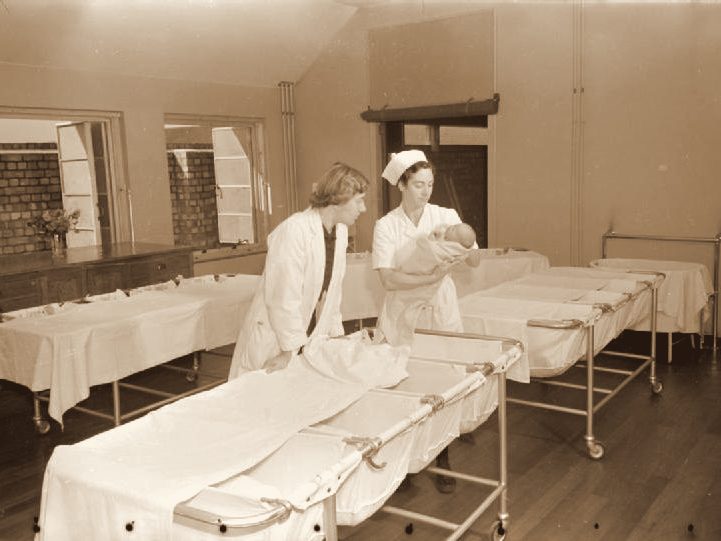
Poplar, 1961. A baby is born with a disability. Nobody yet knows why: later, a medicine called thalidomide, given to pregnant women, is found to be the cause, and it is withdrawn at the end of 1961. The midwife stays with the family. She does not invent a diagnosis: she listens, comforts and tells the truth.Poplar, 1961. Un bébé naît avec un handicap. Personne ne sait encore pourquoi : on découvre ensuite qu’un médicament, la thalidomide, donné aux femmes enceintes, en est la cause ; il est retiré fin 1961. La sage-femme reste auprès de la famille. Elle n’invente pas de diagnostic : elle écoute, réconforte et dit la vérité.
Modal focus: may, might, could: possibility · Would you like…? offering
RecapRappel / 4
Answer in your notebook, without looking. Then check and write your mark out of four.Répondez dans le cahier sans regarder. Puis corrigez et notez-vous sur quatre.
- What can a newborn do? Give two things. 1 pt
- Complete: He ______ smile in six weeks. 1 pt
- How should a baby sleep today? 1 pt
- Give the English for: s’étouffer, consoler, envelopper. 1 pt
Show the answers
- See a face that is close, recognise his mother’s voice, cry, grip a finger.
- will be able to
- On his or her back, in his or her own cot.
- to choke, to comfort, to wrap
Entry versionVersion d’entrée Entry · A2
- “He can’t walk” means: a) il ne peut pas marcher b) il ne veut pas marcher
- A cot is: a) a bed for a baby b) a bottle
Show the answers
- a
- a
What we need to sayCe que nous avons besoin de dire
Today we want to talk to a family when we do not know everything. We must not lie and we must not invent. We need to say what is possible, offer help and show that we listen.
For possibility, English uses may, might, could. To offer, it uses Would you like…? and Shall I…?
DocumentsDocuments
Document A · The clip
Watch the official extract once without writing. The second time, look at the faces, the silences and the hands. Who speaks? Who listens?
Official channel Thalidomide (Call the Midwife Official Video Channel)
Short public extract, not a full episode.
Document B · Florence Nightingale, Notes on Nursing (1859)
“Apprehension, uncertainty, waiting, expectation, fear of surprise, do a patient more harm than any exertion.”Chapter III, “Petty management”
“Always sit down when a sick person is talking business to you …”Chapter IV, “Noise”
Document C · After the birth (written for this lesson)
Father: Why is his arm like that? Is it our fault?
Midwife (she sits down): No. It isn’t your fault. I don’t know why yet. The doctor will examine him this afternoon. It might take time to understand.
Mother: Will he be in pain?
Midwife: I don’t think so. He is feeding well and he is warm. The doctor may have more answers. Would you like me to stay while he examines him?
Father: Yes, please.
Midwife: Would you like to hold him? He might like to hear your voice.
Mother (crying): I’m sorry.
Midwife: You don’t have to be sorry. You can cry. Shall I make you a cup of tea? I’m here.
Father: I feel cold. My head is turning.
Midwife: You could be in shock. Sit down here, lie back and raise your legs on this chair. I’ll put a blanket on you.
Document D · Facts
- Thalidomide was sold in the United Kingdom from 1958, often to calm morning sickness. It was withdrawn at the end of 1961.
- Thousands of babies around the world were born with disabilities, often of the arms and legs. In the United Kingdom, survivors still receive support from the Thalidomide Trust.
- Since then, every new medicine must be tested much more carefully before it is sold.
- First aid for shock (NHS advice): the person may be pale, cold, sweaty and dizzy. Help them lie down, raise their legs, keep them warm, reassure them and call 15, 112 or 999 if it is serious.
Understand the documentsComprendre les documents Entry · A2 Core · B1
- Clip: who is in the room? Who speaks most, who listens most?
- Clip: note one gesture of comfort.
- Nightingale: list three things that harm a patient more than effort.
- Nightingale: what should you do when a sick person talks to you about something important?
- Document C: what does the midwife do first when she answers the father?
- Document C: does the midwife give a diagnosis? Why?
- Document C: find three offers.
- Document C: what are the signs of shock in the father, and what does the midwife do?
- Document D: when was thalidomide withdrawn in the UK?
Show the answers
- Answers depend on the extract: the midwife, the mother, the father, the doctor. Note who speaks and who stays silent.
- Examples: holding a hand, sitting down, holding the baby, a look, a silence.
- Apprehension, uncertainty, waiting, expectation, fear of surprise (any three).
- Sit down.
- She sits down (as Nightingale advises).
- No. She doesn’t know yet; the doctor will examine the baby. She doesn’t invent.
- Would you like me to stay? Would you like to hold him? Shall I make you a cup of tea?
- He feels cold and dizzy. She makes him lie back, raises his legs and puts a blanket on him.
- At the end of 1961.
Words to say itLes mots pour le dire
The stressed syllable is in capitals.
First aid
| shock shok | l’état de choc |
| pale payl | pâle |
| sweaty SWET-ee | en sueur |
| to raise the legs rayz | surélever les jambes |
| a blanket BLANG-kit | une couverture |
| to examine ig-ZAM-in | examiner |
Accompaniment
| to comfort KUM-fert | réconforter |
| to listen LIS-en | écouter |
| to stay with | rester avec |
| a silence SAI-lens | un silence |
| tears teerz | les larmes |
| a disability dis-a-BIL-i-tee | un handicap |
| disabled dis-AY-bld | handicapé, en situation de handicap |
| the truth trooth | la vérité |
| a fault fawlt | une faute |
| a family FAM-i-lee | une famille |
| support su-PORT | le soutien |
| to feel guilty GIL-tee | se sentir coupable |
Vocabulary practiceEntraînement lexical
A. Feelings and gestures Entry · A2
Match.
- tears: a) les larmes b) les déchirures
- to comfort: a) to make someone feel less sad b) to make a bed
- pale: a) white in the face b) red in the face
- a blanket: a) to keep warm b) to wash
- the truth: a) what is real b) what is invented
- guilty: a) feeling that it is your fault b) feeling hungry
Show the answers
- a
- a
- a
- a
- a
- a
B. Complete the midwife’s words Entry · A2
Use each word once.
faultsitstayholdcryblankettruthlisten
- It isn’t your ______.
- I always ______ down to talk.
- Would you like me to ______?
- Would you like to ______ him?
- You can ______.
- I’ll put a ______ on you.
- I tell the ______: I don’t know yet.
- I’m here to ______ to you.
Show the answers
- fault
- sit
- stay
- hold
- cry
- blanket
- truth
- listen
C. What helps, what hurts? Entry · A2
Sort the attitudes: helps (H) or hurts (Hu).
- sitting down
- standing at the door, in a hurry
- saying “Everything will be fine!” when you don’t know
- saying “I don’t know yet, the doctor will explain”
- offering a cup of tea
- talking about the baby in the corridor with other families
- staying in silence with the family
Show the answers
- H
- Hu
- Hu
- H
- H
- Hu
- H
D. Respectful words Core · B1
Which expression is respectful today? Choose and explain.
- a) a handicapped baby b) a baby with a disability
- a) a disabled person b) a person with a disability
- a) a victim of thalidomide b) a thalidomide survivor
- a) normal babies b) other babies
Show the answers
- b: we name the person first.
- both are used in the UK; ask the person what they prefer.
- b: survivors themselves often prefer this word.
- b: “normal” suggests the baby is not normal.
E. Word building Core · B1
Complete.
- able → (noun) ______ → (opposite) ______
- to comfort → (adjective) ______
- true → (noun) ______
- to support → (noun for a person) ______
- silent → (noun) ______
Show the answers
- ability, disability
- comfortable / comforting
- truth
- a supporter (a support worker)
- silence
Grammar lessonLeçon de grammaire
Grammar point 1 · may, might, could: saying what is possible without lying
Teacher scriptScript de l’enseignante
“The father asks: Is it our fault? Will he be in pain? The midwife cannot be sure. She doesn’t lie, she doesn’t invent. Listen to her verbs: might, may, could. On the board, let’s draw a line of certainty from 0 to 100%.”
On the board · copy in your notebookAu tableau · à recopier
- Rule
- Possibility: may, might, could. Certainty: is, will. Impossibility: can’t.
- Form
- may / might / could + verb · may not / might not + verb · He could be… (possible) ≠ He can’t be… (impossible)
- Use
- To speak honestly to a patient or a family, to describe symptoms in a report, to avoid inventing a diagnosis.
- Examples from the lesson
- It might take time to understand.
- The doctor may have more answers.
- You could be in shock.
- Common mistakes
It might takes time.→ It might take time.Maybe he might be…→ Maybe he is… / He might be…He couldn’t be in pain(meaning “maybe not”) → He might not be in pain.
- French and English
- « Il se peut que… / Peut-être que… » = may / might + verb, or maybe + present. Never two (
maybe he might).
Quick check
- Not sure: He ______ be cold.
- Rewrite: Maybe she is tired.
- Offer: ______ I call the doctor?
Show the answers
- may / might
- She might be tired.
- Shall
Grammar point 2 · Present perfect or past simple?
Teacher scriptScript de l’enseignante
“The baby has been born. The drug was withdrawn at the end of 1961. Both are in the past… so why two tenses? The first is news, it matters now. The second has a date. Let’s write the rule with two columns: no date / date.”
On the board · copy in your notebookAu tableau · à recopier
- Rule
- Present perfect: an action in the past with a result now, no precise date. Past simple: a finished action with a date or a finished time.
- Form
- have / has + past participle (has been born, has eaten) · verb + -ed or irregular (was, withdrew, examined)
- Use
- Present perfect for news and handovers (“He has eaten.”); past simple for history and reports with times (“At 10 o’clock, he ate.”).
- Examples from the lesson
- The baby has been born.
- Thalidomide was withdrawn at the end of 1961.
- He has fed well this morning.
- The doctor examined him at three o’clock.
- Common mistakes
The drug has been withdrawn in 1961.→ The drug was withdrawn in 1961.I have seen him yesterday.→ I saw him yesterday.
- French and English
- French « passé composé » = often past simple in English when there is a date: « Il a été retiré en 1961 » = It was withdrawn in 1961.
Quick check
- In 1958, the drug ______ (go) on sale.
- Good news: the baby ______ (eat).
- Correct: I have called the doctor at 8.
Show the answers
- went
- has eaten
- I called the doctor at 8.
Memo cardFiche mémo
may, might, could + verb: something is possible, we are not sure: It might take time. The doctor may have more answers. You could be in shock. (might is a little less sure than may.)
Negative: may not, might not (never couldn’t for a possibility: couldn’t means impossible).
Offering: Would you like to hold him? (you do it) · Would you like me to stay? (I do it) · Shall I make you a cup of tea?
Grammar practice: from recognition to your own sentencesEntraînement : de la reconnaissance à la production
1. Sure or not sure? Entry · A2
Write S (sure) or P (possible).
- The baby is warm.
- It might take time.
- The doctor may have more answers.
- He is feeding well.
- You could be in shock.
- He might like to hear your voice.
Show the answers
- S
- P
- P
- S
- P
- P
2. Make it less sure Entry · A2
Rewrite with may or might.
- The doctor knows.
- He is cold.
- It takes a long time.
- She is in shock.
- The tests give an answer.
Show the answers
- The doctor may know.
- He might be cold.
- It might take a long time.
- She may be in shock.
- The tests may give an answer.
3. Offers Entry · A2
Make an offer with Would you like (me) to…? or Shall I…?
- You offer to stay.
- You offer the mother the chance to hold the baby.
- You offer to call the grandmother.
- You offer a glass of water.
- You offer to open the window.
Show the answers
- Would you like me to stay?
- Would you like to hold him?
- Shall I call your mother?
- Would you like a glass of water?
- Shall I open the window?
4. Do not invent Core · B1
The family asks; you don’t know. Answer honestly with may, might, could, or I don’t know yet.
- Will he walk?
- Was it the medicine?
- Will he need an operation?
- Is it serious?
Show the answers
- I don’t know yet. The doctor might be able to tell you after the tests.
- We don’t know yet. It could be, but the doctors must check.
- He may need one, he may not. The doctor will explain.
- I can’t say yet. Let’s wait for the doctor; I’ll stay with you.
5. Your own dialogue Core · B1
Write a short dialogue (eight lines) between a carer and a worried relative in a care home: an elderly man has fallen ill in the night. Use two possibilities and two offers.
- Your dialogue.
Show the answers
- Example: Relative: Is he very ill? Carer: He might have an infection; the doctor may come this morning. Would you like to sit with him? Shall I bring you a coffee?
Figure of speechFigure de style: Accumulation (a list that builds up)
“Apprehension, uncertainty, waiting, expectation, fear of surprise, do a patient more harm than any exertion.”Florence Nightingale, Notes on Nursing, 1859, chapter III.
Nightingale piles up five nouns before the verb. The reader feels the waiting grow, like the patient. The list makes us understand that fear is a real pain, sometimes worse than physical effort.
Work on the figureTravailler la figure Core · B1
- How many nouns are there before the verb?
- Find the French for each noun.
- Why is the verb so far from the beginning?
- Write your own accumulation about a family in a waiting room. Start: “Noise, questions, …”
Show the answers
- Five: apprehension, uncertainty, waiting, expectation, fear of surprise.
- appréhension, incertitude, attente, attente anxieuse, peur de la surprise.
- To make the reader wait, like the patient: the form imitates the meaning.
- Example: Noise, questions, cold coffee, the clock on the wall, the closed door: the family waits.
ExpressionExpression
WritingÉcrit: A short note to a colleague (handover) after the difficult birth
Length: 60 words (core), 120 words (stretch).
StepsÉtapes
- Write the time and what has happened (present perfect).
- Write what you did (past simple).
- Write what is possible (may, might).
- Write how the family feels and what they need.
- Write one thing your colleague should do.
Sentence startersDébuts de phrases
- At … o’clock, the baby has been born / the family has…
- I sat with them and…
- The doctor may… / The father might…
- The mother is… She needs…
- You should…
SpeakingOral: Role play: listening to a worried parent (in pairs, three minutes)
StepsÉtapes
- The carer sits down, says their name and listens.
- The parent asks two questions; the carer answers honestly (may, might, I don’t know yet).
- The carer makes two offers.
- The parent feels unwell (shock); the carer gives the first aid gestures.
- The carer ends with a sentence of support.
Sentence startersDébuts de phrases
- Hello, I’m… Can I sit down with you?
- I don’t know yet. It might… / The doctor may…
- Would you like…? Shall I…?
- Lie down, I’ll raise your legs…
- I’m here. You’re not alone.
Swap roles, then perform for the class. The listeners note one good modal and one care gesture.Échangez les rôles, puis jouez devant la classe. Ceux qui écoutent notent un bon modal et un geste de soin.
Going furtherPour aller plus loin Going further · B2
For students who want to go on with languages.Pour les élèves qui veulent poursuivre en langues.
Richer wordsLexique enrichi
| to break bad news | annoncer une mauvaise nouvelle |
| to be in denial | être dans le déni |
| to acknowledge feelings | reconnaître les émotions |
| a congenital condition | une affection congénitale |
| to withdraw a drug | retirer un médicament |
| compassionate | plein de compassion |
Register: I don’t know (honest, oral) → At this stage, it is not possible to give a diagnosis (formal, written).
Modals in the pastLes modaux au passé
Modals in the past: might have / may have / could have = a past possibility: The drug might have caused it. must have = strong deduction: The parents must have been terrified. can’t have = impossible: It can’t have been their fault. should have: The drug should have been tested more.
PractiseEntraînement
- Maybe the drug caused the disability. (past possibility)
- Deduce how the parents felt.
- It was impossible that it was the mother’s fault.
- Criticise the testing of the drug.
Show the answers
- The drug might have caused the disability.
- They must have been terrified.
- It can’t have been the mother’s fault.
- The drug should have been tested more carefully.
Translate into EnglishTraduire en anglais
- Ce n’est pas votre faute.
- Le médecin aura peut-être plus de réponses.
- Voulez-vous que je reste ?
- Le médicament a été retiré fin 1961.
- Ils ont dû être terrifiés.
Show the answers
- It isn’t your fault.
- The doctor may have more answers.
- Would you like me to stay?
- The drug was withdrawn at the end of 1961.
- They must have been terrified.
Argued writingÉcrit argumenté
Argued paragraph (180 words): “Should a carer always tell the whole truth to a family?” Discuss honesty, professional limits (no diagnosis) and kindness. Use Nightingale, Document C and one modal in the past.
Plan: introduction (the question and why it matters) · argument 1 with an example · argument 2 with an example · conclusion (your opinion). Linkers: firstly, moreover, however, on the other hand, therefore, to conclude.
On placement (PFMP)En PFMP
On placement, you will meet families who are worried. Your role is to listen, to reassure and to pass on information to the team. You never give a diagnosis, and you never talk about a patient outside the team: this is professional secrecy. Write in your notebook the name of the person you must inform.
Homework
A. Learn the words Entry · A2
Learn the words of comfort and of shock. Say them aloud with the stress.
B. Possibility and offers Entry · A2
Complete with might, may, would you like or shall.
- He ______ be tired.
- ______ I call your husband?
- ______ to sit down?
- The test ______ take two days.
- ______ me to stay?
Show the answers
- might / may
- Shall
- Would you like
- may / might
- Would you like
C. Tenses Core · B1
Past simple or present perfect?
- The baby ______ (be) born an hour ago.
- Look, he ______ (open) his eyes!
- In 1961, the medicine ______ (be) withdrawn.
Show the answers
- was
- has opened
- was