ASSP route · Session 4 of 6Parcours ASSP · Séance 4 sur 6
Newborn care: “A newborn can’t hold its head up”Soins au nouveau-né : « Un nouveau-né ne peut pas tenir sa tête »
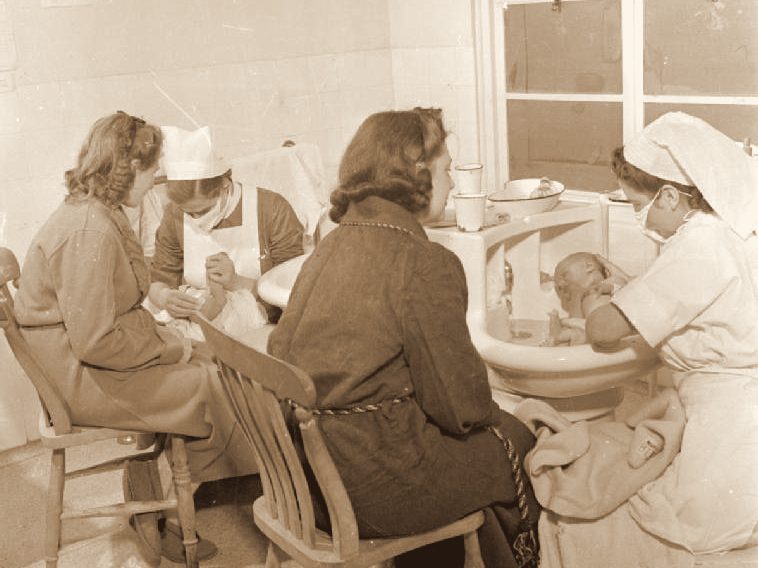
Poplar, 1955. After the birth, the midwife comes back every day for ten days. She shows the young mother how to hold, feed and bath the baby. On placement in a crèche or a maternity ward, you learn the same gestures, with today’s safety rules.Poplar, 1955. Après la naissance, la sage-femme revient chaque jour pendant dix jours. Elle montre à la jeune maman comment tenir, nourrir et baigner le bébé. En PFMP en crèche ou en maternité, vous apprenez les mêmes gestes, avec les règles de sécurité d’aujourd’hui.
Modal focus: can, can’t, be able to: what a baby can do
RecapRappel / 4
Answer in your notebook, without looking. Then check and write your mark out of four.Répondez dans le cahier sans regarder. Puis corrigez et notez-vous sur quatre.
- Give one piece of advice for a damp room. 1 pt
- should or must? “You ______ call 15 if he is not breathing.” 1 pt
- Finish: “I close the curtain so that…” 1 pt
- Give the English for: serviette, savon, dignité, autonomie. 1 pt
Show the answers
- You should open the window every morning (and cover the patient so she doesn’t get cold).
- must
- …nobody can see the patient.
- a towel, soap, dignity, independence
Entry versionVersion d’entrée Entry · A2
- “You should” is: a) advice b) a ban
- A towel is used to: a) dry b) cook
Show the answers
- a
- a
What we need to sayCe que nous avons besoin de dire
Today we want to describe what a newborn can and cannot do, so that we can explain to a parent how to care for the baby safely. We also want to say what the baby will be able to do later.
For ability, English uses can / can’t (now), could (in the past) and will be able to (in the future).
DocumentsDocuments
Document A · The clip
This short documentary explains how babies were born in the East End in the 1950s. Watch and note where the mothers gave birth and who helped them.
Documentary Documentary: giving birth in the East End, 1955 (Mr & Mrs History)
Short public extract, not a full episode.
Document B · Bath time, 1955 (written for this lesson)
Midwife: Your baby can’t hold his head up yet, so you must always support it with your hand, like this.
Mother: He is so small! Can he see me?
Midwife: Yes, he can see your face when you are close, and he can already recognise your voice. He can’t see far away yet.
Mother: When will he be able to smile?
Midwife: In about six weeks. Now, the bath. First, test the water with your elbow: it should be warm, not hot. Never leave him alone in the bath, not even for a second.
Mother: He’s crying! What can I do?
Midwife: He can’t tell you what he wants, so he cries. Maybe he is cold, maybe he is hungry. Wrap him in the towel and hold him against you. You can talk to him softly.
Document C · Then and now
- In the 1950s, many babies in Poplar were born at home with a midwife.
- Today, most babies in the United Kingdom are born in hospital.
- Since the “Back to Sleep” campaign of 1991 in the United Kingdom, parents are told to put babies to sleep on their back, in their own cot, never on their tummy.
- Choking baby (NHS advice): if the baby can’t cough, cry or breathe, give up to five back blows, then up to five chest thrusts, and call 999 (in France, 15 or 112) if it doesn’t work.
Understand the documentsComprendre les documents Entry · A2 Core · B1
- Clip: where did most East End mothers give birth in the 1950s?
- Bath time: why must the mother support the baby’s head?
- Bath time: what can the baby already do? Give two things.
- Bath time: how do you test the water?
- Bath time: what is the absolute rule in the bath?
- Bath time: why does a baby cry? Give two possible reasons.
- Then and now: how should a baby sleep today?
- Then and now: what are the first gestures for a choking baby?
Show the answers
- At home (with a midwife). Accept details you hear.
- Because he can’t hold his head up yet.
- See his mother’s face when she is close; recognise her voice; cry.
- With your elbow: it should be warm, not hot.
- Never leave the baby alone, not even for a second.
- He is cold, he is hungry (he can’t say what he wants).
- On his or her back, in his or her own cot.
- Up to five back blows, then up to five chest thrusts, then call for help.
Words to say itLes mots pour le dire
The stressed syllable is in capitals.
First aid
| to choke chohk | s’étouffer |
| back blows | des tapes dans le dos |
| chest thrusts | des compressions thoraciques |
| to cough kof | tousser |
| a temperature TEM-pra-cher | la température, la fièvre |
| to support the head su-PORT | soutenir la tête |
Accompaniment
| a newborn NYOO-born | un nouveau-né |
| a cot kot | un lit de bébé |
| to feed feed | nourrir |
| a bottle BOT-l | un biberon |
| a nappy NAP-ee | une couche |
| to bath a baby bahth | baigner un bébé |
| to wrap rap | envelopper |
| to hold hohld | tenir dans les bras |
| to cry krai | pleurer |
| to comfort KUM-fert | consoler, réconforter |
| to recognise REK-og-naiz | reconnaître |
| a parent PAIR-ent | un parent |
Vocabulary practiceEntraînement lexical
A. Baby words Entry · A2
Match.
- a cot: a) a bed for a baby b) a coat
- a nappy: a) a short sleep b) une couche
- a bottle: a) a biberon b) a bath
- to wrap: a) to cover with a towel or blanket b) to wash
- to choke: a) to cough because something blocks the throat b) to sing
- to comfort: a) to make a baby feel better b) to feed a baby
Show the answers
- a
- b
- a
- a
- a
- a
B. Complete the advice for a young parent Entry · A2
Use each word once.
supportelbowalonebackwrapfeednappycry
- Always ______ the baby’s head.
- Test the water with your ______.
- Never leave the baby ______ in the bath.
- Put the baby to sleep on his ______.
- After the bath, ______ him in a warm towel.
- You can ______ him every three hours.
- Change his ______ after the meal.
- Babies ______ when they are hungry.
Show the answers
- support
- elbow
- alone
- back
- wrap
- feed
- nappy
- cry
C. Then or now? Entry · A2
Write T (1950s) or N (today), or B (both).
- Most babies are born at home.
- Most babies are born in hospital.
- Babies sleep on their back.
- The midwife visits the mother at home after the birth.
- You test the bath water with your elbow.
Show the answers
- T
- N
- N
- B (today a midwife or a health visitor still visits at home)
- B
D. Verb or noun? Core · B1
Find the noun.
- to feed → ______
- to cry → ______
- to breathe → ______
- to choke → ______
- to support → ______
- to comfort → ______
Show the answers
- a feed / feeding
- a cry
- breath / breathing
- choking
- support
- comfort
E. The right preposition Core · B1
Complete with on, in, under, against, with.
- Put the baby to sleep ______ his back.
- He sleeps ______ his own cot.
- Put your hand ______ his head.
- Hold him ______ you.
- Test the water ______ your elbow.
Show the answers
- on
- in
- under
- against
- with
Grammar lessonLeçon de grammaire
Grammar point 1 · Ability: can, could, will be able to
Teacher scriptScript de l’enseignante
“The mother asks: Can he see me? When will he be able to smile? Two questions, two times: now and later. Can has no future form, so English borrows be able to. Let’s draw a timeline on the board: 1955, today, tomorrow.”
On the board · copy in your notebookAu tableau · à recopier
- Rule
- Ability: can (now), could (past), will be able to (future).
- Form
- can / can’t + verb · could / couldn’t + verb · will be able to + verb · Can he…? · When will he be able to…?
- Use
- To describe a baby’s development, a patient’s abilities (mobility, independence), and to compare then and now.
- Examples from the lesson
- He can’t hold his head up yet.
- He can see your face.
- When will he be able to smile?
- In 1955, few families could call an ambulance.
- Common mistakes
He will can smile.→ He will be able to smile.He can to see.→ He can see.He don’t can walk.→ He can’t walk.
- French and English
- French: « il pourra » (future of pouvoir). English: will be able to, never
will can.
Quick check
- Future: He ______ walk next year.
- Past: She ______ swim when she was six.
- Correct: He can’t to talk.
Show the answers
- will be able to
- could
- He can’t talk.
Grammar point 2 · Present simple or present continuous? Prepositions of place
Teacher scriptScript de l’enseignante
“Two sentences: Babies cry when they are hungry. He’s crying! One is a general truth, one is happening now. Which is which? Then: where does the baby sleep? On his back, in his cot. Let’s draw the cot and place the prepositions.”
On the board · copy in your notebookAu tableau · à recopier
- Rule
- Present simple: general truth, habit, protocol. Present continuous: happening now. Place: on (surface), in (inside), under, against, next to.
- Form
- Babies cry. · He is (He’s) crying. · on his back · in his cot · under his head · against you
- Use
- Present simple for advice sheets and protocols; present continuous to describe what you see during a care.
- Examples from the lesson
- Babies cry when they are hungry.
- He’s crying! What can I do?
- Put him to sleep on his back, in his own cot.
- Hold him against you.
- Common mistakes
He cry now.→ He is crying now.Babies are crying when hungry(general) → Babies cry when they are hungry.He sleeps in his back.→ He sleeps on his back.
- French and English
- French uses one present for both: « Il pleure » = He cries (habit) or He is crying (now). English chooses.
Quick check
- Now: Look! The baby ______ (smile).
- Habit: Newborns ______ (sleep) a lot.
- Babies sleep ______ their back.
Show the answers
- is smiling
- sleep
- on
Memo cardFiche mémo
can / can’t + verb: ability now: He can see your face. He can’t hold his head up.
could / couldn’t: ability in the past: In 1955, few mothers could go to hospital.
will be able to: ability in the future: He will be able to smile in six weeks.
Question: Can he see me? When will he be able to smile?
Grammar practice: from recognition to your own sentencesEntraînement : de la reconnaissance à la production
1. Recognise Entry · A2
Now, past or future?
- He can see your face.
- He will be able to sit up at six months.
- My grandmother could not go to hospital.
- He can’t hold his head up.
- When will he be able to walk?
- In 1955, the midwife could come every day.
Show the answers
- now
- future
- past
- now
- future
- past
2. can or can’t? Entry · A2
A newborn… Complete.
- A newborn ______ walk.
- A newborn ______ cry.
- A newborn ______ recognise his mother’s voice.
- A newborn ______ talk.
- A newborn ______ hold his head up.
- A newborn ______ see a face that is close.
Show the answers
- can’t
- can
- can
- can’t
- can’t
- can
3. Transform into the future Core · B1
Use will be able to.
- He can’t smile yet. (six weeks)
- He can’t sit up yet. (six months)
- He can’t eat with a spoon yet. (six months)
- He can’t walk yet. (about one year)
- He can’t say “Mummy” yet. (about one year)
Show the answers
- He will be able to smile in six weeks.
- He will be able to sit up at about six months.
- He will be able to eat from a spoon at about six months.
- He will be able to walk at about one year.
- He will be able to say “Mummy” at about one year.
4. Then and now Core · B1
Make sentences with could (then) and can (now).
- give birth at home / give birth in hospital
- see a midwife at home / see a midwife or a health visitor at home
- not / call an ambulance easily / call 15 from any phone
Show the answers
- In 1955, most mothers could only give birth at home. Today, they can give birth in hospital.
- In 1955, mothers could see a midwife at home. Today, they can still see a midwife or a health visitor at home.
- In 1955, many families couldn’t call an ambulance easily. Today, they can call 15 or 112 from any phone.
5. Explain to a parent Core · B1
For each ability, give the safety advice that follows.
- He can’t hold his head up.
- He can roll over at four months.
- He can’t control his temperature well.
- He can put things in his mouth.
Show the answers
- So you must always support his head.
- So you mustn’t leave him alone on the changing table.
- So you should check that he is not too hot or too cold.
- So you must keep small objects away from him.
6. Your production Core · B1
Write a short “What can your baby do?” card for parents in a crèche: four things he can do, two things he can’t do yet, two things he will be able to do soon.
- Your card.
Show the answers
- Example: Your baby can recognise your voice, can cry to call you, can grip your finger, can see your face. He can’t hold his head up yet, he can’t sit up. Soon, he will be able to smile and to laugh.
Figure of speechFigure de style: Metonymy and a pair of opposites
“from the cradle to the grave”The motto of the British welfare state, used for the Beveridge plan (see session 01 of the learning journey).
The cradle (a baby’s bed) stands for birth, the grave stands for death. Two objects say the whole of life in four words: the State helps you all your life.
Work on the figureTravailler la figure Core · B1
- What does the cradle stand for? And the grave?
- Find a modern word for “cradle” in Document B.
- Translate the expression into French.
- Invent a slogan for a crèche with two objects that stand for something. Start: “From the first bottle to…”
Show the answers
- Birth; death.
- a cot
- « du berceau à la tombe »
- Example: From the first bottle to the first steps, we are by your side.
ExpressionExpression
WritingÉcrit: A welcome card for parents in a crèche
Length: 50 words (core), 100 words (stretch).
StepsÉtapes
- Write a title and say hello to the parents.
- Write three things their baby can do.
- Write two things their baby can’t do yet, with the safety advice.
- Write one thing their baby will be able to do soon.
- End with a sentence of comfort.
Sentence startersDébuts de phrases
- Welcome to…! Dear parents,
- Your baby can…
- Your baby can’t… yet, so you should…
- Soon, your baby will be able to…
- Don’t worry, we…
SpeakingOral: Role play: the first bath (in pairs, three minutes)
StepsÉtapes
- The parent is worried; the carer greets and reassures.
- The carer explains two things the baby can’t do and the safety gestures.
- The baby cries (the partner says “He’s crying!”); the carer explains and comforts.
- The parent asks one question with “When will he be able to…?”
- The carer answers and gives one final piece of advice.
Sentence startersDébuts de phrases
- Hello, don’t worry, I’ll show you.
- He can’t… yet, so we must…
- He’s crying because… We can…
- He will be able to… in…
- Remember: never…
Swap roles, then perform for the class. The listeners note one good modal and one care gesture.Échangez les rôles, puis jouez devant la classe. Ceux qui écoutent notent un bon modal et un geste de soin.
Going furtherPour aller plus loin Going further · B2
For students who want to go on with languages.Pour les élèves qui veulent poursuivre en langues.
Richer wordsLexique enrichi
| neonatal care | les soins néonatals |
| to swaddle | emmailloter |
| safe sleep guidance | les recommandations pour un sommeil sûr |
| a health visitor | une puéricultrice de secteur (au Royaume-Uni) |
| to latch on | prendre le sein (registre spécialisé) |
| cot death (SIDS) | la mort subite du nourrisson |
Register: Put him on his back (oral advice) → Infants should be placed on their back to sleep (official guidance, passive).
Modals in the pastLes modaux au passé
Modals in the past: could have = a possibility in the past: The baby could have choked. must have = deduction: He must have been hungry. needn’t have: You needn’t have woken him for the feed. was able to = managed to, once: She was able to stop the choking.
PractiseEntraînement
- The baby stopped crying after the bottle. Deduce.
- The mother left the baby alone on the table, but nothing happened.
- The father woke the baby for a feed, but the baby was fine.
- The carer gave back blows and the baby breathed again.
Show the answers
- He must have been hungry.
- He could have fallen.
- He needn’t have woken him.
- She was able to stop the choking.
Translate into EnglishTraduire en anglais
- Il ne peut pas encore tenir sa tête.
- Il pourra sourire dans six semaines.
- Ne laissez jamais le bébé seul dans le bain.
- Il devait avoir faim.
- Couchez-le sur le dos.
Show the answers
- He can’t hold his head up yet.
- He will be able to smile in six weeks.
- Never leave the baby alone in the bath.
- He must have been hungry.
- Put him to sleep on his back.
Argued writingÉcrit argumenté
Argued paragraph (150 to 180 words): “Giving birth at home in 1955 or in hospital today: what has care gained, and what has it lost?” Use Document C, the clip and your own knowledge. Use could, was able to and could have.
Plan: introduction (the question and why it matters) · argument 1 with an example · argument 2 with an example · conclusion (your opinion). Linkers: firstly, moreover, however, on the other hand, therefore, to conclude.
On placement (PFMP)En PFMP
On placement in a crèche or a maternity ward, you follow the protocols for the bath, the changing table and sleep. You never leave a baby alone on the changing table. Ask your tutor how parents are welcomed and write two sentences you hear.
Homework
A. Learn the words Entry · A2
Learn the baby care and first aid words.
B. can, can’t, will be able to Entry · A2
Complete.
- A newborn ______ walk.
- He ______ smile in six weeks.
- He ______ recognise your voice.
- In 1955, the midwife ______ come every day.
- He ______ sit up at six months.
Show the answers
- can’t
- will be able to
- can
- could
- will be able to
C. Then and now Core · B1
Write three sentences comparing baby care in 1955 and today, with could and can.
- Three sentences.
Show the answers
- Examples: In 1955, mothers could give birth at home with a midwife; today they can choose a hospital. In 1955, families couldn’t always call an ambulance; today they can call 15.