ASSP route · Session 3 of 6Parcours ASSP · Séance 3 sur 6
Hygiene and home care: “You should wash your hands”Hygiène et soins à domicile : « Vous devriez vous laver les mains »
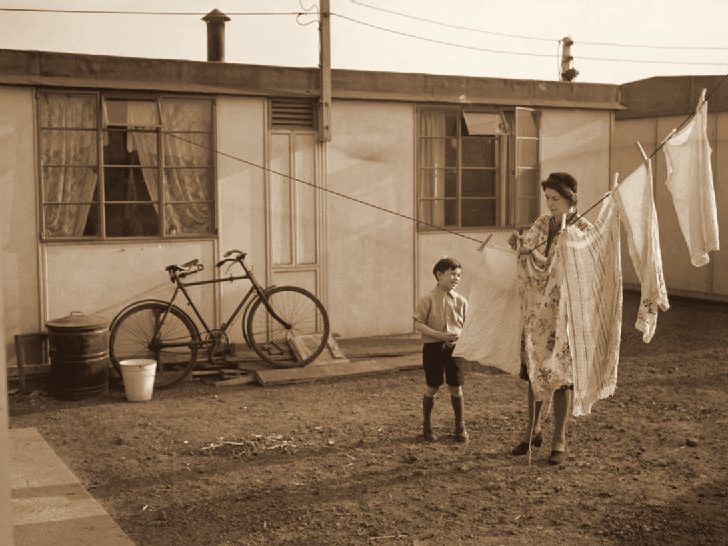
Poplar, 1961. Many families still live in damp, crowded houses, with no bathroom. The district nurse helps an elderly lady to wash and get dressed, and gives advice to her daughter. On placement at home or in a care home, you help with the same gestures.Poplar, 1961. Beaucoup de familles vivent encore dans des maisons humides et surpeuplées, sans salle de bains. L’infirmière du quartier aide une dame âgée à se laver et à s’habiller, et conseille sa fille. En PFMP à domicile ou en EHPAD, vous faites les mêmes gestes.
Modal focus: should, shouldn’t, ought to: advice
RecapRappel / 4
Answer in your notebook, without looking. Then check and write your mark out of four.Répondez dans le cahier sans regarder. Puis corrigez et notez-vous sur quatre.
- Give two rules for an unconscious person who is breathing. 1 pt
- mustn’t or don’t have to: “You ______ put butter on a burn.” 1 pt
- When did 999 start? 1 pt
- Give the English for: plaie, brûlure, trousse de secours. 1 pt
Show the answers
- Put them in the recovery position; call 15, 112 or 999; stay with them; check their breathing.
- mustn’t
- In 1937 (30 June, in London).
- a wound, a burn, a first aid kit
Entry versionVersion d’entrée Entry · A2
- CPR is: a) a massage of the chest b) a phone number
- “You mustn’t” means: a) it is forbidden b) it is not necessary
Show the answers
- a
- a
What we need to sayCe que nous avons besoin de dire
Today we want to give advice to a patient and to her family, without giving orders. We also want to explain why we do each gesture of hygiene, to respect the person’s dignity.
For advice, English uses should and ought to; for a bad idea, shouldn’t. To explain why, we need linking words: because, so, to + verb, so that.
DocumentsDocuments
Document A · The clip
The cast of the series explain how the East End, its houses and its people change at the start of the 1960s. Watch and note what you see about houses and living conditions.
Official channel Into the sixties: the East End changes (Call the Midwife Official Video Channel, behind the scenes)
Short public extract, not a full episode.
Document B · Florence Nightingale, Notes on Nursing (1859)
“Every nurse ought to be careful to wash her hands very frequently during the day. If her face too, so much the better.”Chapter XI, “Personal cleanliness”
“The very first canon of nursing, the first and the last thing upon which a nurse’s attention must be fixed … is this: TO KEEP THE AIR HE BREATHES AS PURE AS THE EXTERNAL AIR, WITHOUT CHILLING HIM.”Chapter I, “Ventilation and warming”
Florence Nightingale (1820 to 1910) trained nurses in London. Her book is in the public domain. A “canon” here means a basic rule.
Document C · A morning with Mrs O’Brien, 1961 (written for this lesson)
Nurse: Good morning, Mrs O’Brien. Shall we have a wash? First, I’ll wash my hands. Then I’ll close the curtain, so that nobody can see you.
Mrs O’Brien: I can wash my face myself, you know.
Nurse: Of course. You should do everything you can: it keeps you strong. I’ll do your back and your feet.
Daughter: Should I open the window? The room smells of damp.
Nurse: Yes, you ought to open it every morning, but you shouldn’t let your mother get cold. Cover her with a towel.
Daughter: Last week she burnt her hand on the kettle.
Nurse: Then you should keep the kettle at the back of the stove. If it happens again, cool the burn under cold running water for a long time. You shouldn’t put butter on it, whatever the neighbours say.
Nurse: Now, which dress would you like today, Mrs O’Brien? The blue one or the grey one?
Document D · Then and now: three facts
- In 1951, more than a third of homes in England and Wales had no bath, and many shared an outside toilet (census of 1951).
- Today, the NHS asks people to wash their hands with soap and water for about twenty seconds, the time to sing “Happy Birthday” twice.
- For a burn, the NHS advises cool or lukewarm running water for twenty minutes, and never ice, butter or cream.
Understand the documentsComprendre les documents Entry · A2 Core · B1
- Clip: name two things that change in the East End in the early 1960s.
- Nightingale: what should a nurse do very often?
- Nightingale: what is “the first and the last” rule of nursing?
- Document C: why does the nurse close the curtain?
- Document C: why does the nurse let Mrs O’Brien wash her face herself?
- Document C: what two pieces of advice does the daughter receive about the window?
- Document C: what is the mistake with the burn?
- Document C: how does the nurse respect the patient’s choice at the end?
- Document D: what was missing in many homes in 1951?
Show the answers
- Answers depend on what you hear: old houses are pulled down, new estates and tower blocks, families move, new ways of life.
- Wash her hands (and her face too).
- To keep the air the patient breathes as pure as the air outside, without making him cold.
- So that nobody can see Mrs O’Brien: to respect her privacy and dignity.
- To keep her independent and strong: she should do everything she can.
- Open it every morning, but don’t let her mother get cold: cover her with a towel.
- People put butter on a burn; she should cool it under running water instead.
- She asks her which dress she would like.
- A bath (and an indoor toilet).
Words to say itLes mots pour le dire
The stressed syllable is in capitals.
First aid
| a burn burn | une brûlure |
| to cool kool | refroidir |
| running water RUN-ing WAW-ter | l’eau courante |
| a kettle KET-l | une bouilloire |
| to get cold | prendre froid |
| germs jermz | les microbes |
Accompaniment
| to wash wosh | laver, se laver |
| to have a wash | faire sa toilette |
| a bed bath | une toilette au lit |
| to help someone get dressed | aider quelqu’un à s’habiller |
| a towel TOW-el | une serviette |
| soap sohp | le savon |
| gloves gluvz | des gants |
| dignity DIG-ni-tee | la dignité |
| independence in-di-PEN-dens | l’autonomie |
| an elderly person EL-der-lee | une personne âgée |
| a carer KAIR-er | un aidant, une aide-soignante |
| damp damp | humide |
Vocabulary practiceEntraînement lexical
A. What do you need? Entry · A2
Match the action and the object.
- to wash your hands: a) soap b) a kettle
- to dry the patient: a) a towel b) a curtain
- to protect your hands: a) gloves b) shoes
- to protect privacy: a) a curtain b) a window
- to cool a burn: a) running water b) butter
- to air the room: a) open the window b) close the door
Show the answers
- a
- a
- a
- a
- a
- a
B. Complete the care sheet Entry · A2
Use each word once.
soapglovestoweldignitydresseddampgermsbed bath
- Wash your hands with ______ and water.
- Wear ______ for the bed bath.
- Cover the patient with a ______.
- Close the door to respect her ______.
- Help her to get ______.
- The walls are ______: open the window every day.
- Hand washing kills ______.
- She can’t stand up: give her a ______.
Show the answers
- soap
- gloves
- towel
- dignity
- dressed
- damp
- germs
- bed bath
C. Good practice or bad practice? Entry · A2
Write G (good) or B (bad), then correct the bad ones.
- The carer closes the curtain before the wash.
- The carer washes the patient’s face when she can do it herself.
- The carer asks which clothes the patient wants.
- The carer leaves the window open and the patient is cold.
- The carer puts butter on a burn.
- The carer washes her hands before and after the care.
Show the answers
- G
- B: let her do what she can.
- G
- B: cover her with a towel, or close the window.
- B: cool it under running water.
- G
D. Opposites and synonyms Core · B1
Find the opposite or a synonym in the documents.
- dirty (opposite)
- dry (opposite, about a wall)
- dependent (opposite)
- old (a polite synonym)
- to heat (opposite)
- a helper at home (synonym)
Show the answers
- clean
- damp
- independent
- elderly
- to cool
- a carer
E. Collocations Core · B1
Make expressions and use three of them in sentences.
havegetrespectairweardry
- ______ a wash
- ______ dressed
- ______ her dignity
- ______ the room
- ______ gloves
- ______ her back
Show the answers
- have
- get
- respect
- air
- wear
- dry
Grammar lessonLeçon de grammaire
Grammar point 1 · should, ought to, shouldn’t: giving advice
Teacher scriptScript de l’enseignante
“Nightingale wrote: a nurse ought to wash her hands. She doesn’t say must. Why? Because she advises. In Document C, the nurse advises the daughter too. Find every should, ought to and shouldn’t, and we will put them on the board with the order verbs from last time.”
On the board · copy in your notebookAu tableau · à recopier
- Rule
- Advice = should / ought to. Bad idea = shouldn’t. Stronger than advice: must.
- Form
- should + verb · ought to + verb · shouldn’t + verb · Should I…?
- Use
- To advise a patient or a family, to write a care leaflet, to suggest a better way without giving an order.
- Examples from the lesson
- Every nurse ought to wash her hands very frequently. (Nightingale)
- You should do everything you can.
- You shouldn’t put butter on it.
- Should I open the window?
- Common mistakes
You should to open.→ You should open.You ought open.→ You ought to open.Do I should…?→ Should I…?
- French and English
- « Vous devriez » = you should. « Il faudrait » = you ought to / you should. « Vous devez » is often must or have to: be careful, it is stronger.
Quick check
- Advice: You ______ rest.
- Bad idea: You ______ smoke.
- Question: ______ I call the doctor?
Show the answers
- should
- shouldn’t
- Should
Grammar point 2 · Explaining why: because, so, to, so that
Teacher scriptScript de l’enseignante
“A carer never does a gesture without a reason. ‘I close the curtain… why?’ (So that nobody can see you.) Let’s collect the reasons from the dialogue and see the four ways to say them.”
On the board · copy in your notebookAu tableau · à recopier
- Rule
- Cause: because + clause. Consequence: so + clause. Purpose: to + verb, or so that + clause.
- Form
- I open the window because the room is damp. · The room is damp, so I open the window. · I wear gloves to protect the patient. · I close the curtain so that nobody can see you.
- Use
- To explain a care gesture to the patient or to the tutor, to justify a choice in a report.
- Examples from the lesson
- I’ll close the curtain, so that nobody can see you.
- You should do everything you can: it keeps you strong.
- Cover her with a towel so that she doesn’t get cold.
- Common mistakes
I wear gloves for protect.→ I wear gloves to protect.Because the room is damp.(alone) → I open the window because the room is damp.
- French and English
- « pour + infinitif » = to + verb, never
for + verb. « pour que » = so that.
Quick check
- I wash my hands ______ kill the germs.
- She is cold, ______ I close the window.
- Join: I speak slowly / she understands
Show the answers
- to
- so
- I speak slowly so that she understands.
Memo cardFiche mémo
should / ought to + verb: advice, a good idea: You should keep the kettle at the back. You ought to open the window.
shouldn’t + verb: a bad idea: You shouldn’t put butter on it.
Question: Should I open the window?
Advice is softer than an order: You must (rule) → You should (advice). With a patient and a family, advice respects their choice.
Grammar practice: from recognition to your own sentencesEntraînement : de la reconnaissance à la production
1. Order or advice? Entry · A2
Is it an order (must) or advice (should)?
- You must call 15.
- You should open the window every morning.
- You ought to rest after lunch.
- You mustn’t touch the defibrillator pads.
- You shouldn’t carry heavy bags.
- Should I help her?
Show the answers
- order
- advice
- advice
- order (ban)
- advice
- asking for advice
2. should or shouldn’t? Entry · A2
Complete.
- You ______ wash your hands before a care.
- You ______ talk about a patient in the street.
- You ______ let her choose her clothes.
- You ______ leave a damp towel on the bed.
- She ______ drink water every day.
- You ______ rush an elderly person.
Show the answers
- should
- shouldn’t
- should
- shouldn’t
- should
- shouldn’t
3. Transform: from order to advice Core · B1
Make it softer with should or ought to.
- Open the window!
- Don’t stay in bed all day!
- Drink more water!
- Don’t walk without your stick!
- Wear warm socks!
Show the answers
- You should open the window.
- You shouldn’t stay in bed all day.
- You ought to drink more water.
- You shouldn’t walk without your stick.
- You should wear warm socks.
4. Give advice for each problem Core · B1
Use should or shouldn’t, and because or so that.
- The bedroom smells of damp.
- Her skin is very dry.
- She is afraid of falling in the bath.
- She burnt her hand last week.
- She wants to do her hair herself.
Show the answers
- You should open the window every morning, so that the air is clean.
- You should use a cream after the wash because dry skin can crack.
- She should sit on a chair in the shower, so that she doesn’t fall.
- You should keep the kettle at the back, because children and old people can knock it.
- You should let her, because it keeps her independent.
5. Your advice leaflet Core · B1
Write six pieces of advice for a family who cares for an elderly person at home (hygiene, air, burns, dignity).
- Six sentences.
Show the answers
- Examples: You should wash your hands before and after the care. You ought to air the room every morning. You shouldn’t leave her alone in the bath. You should let her choose her clothes…
Figure of speechFigure de style: Antithesis and emphasis
“The very first canon of nursing, the first and the last thing upon which a nurse’s attention must be fixed … is this: TO KEEP THE AIR HE BREATHES AS PURE AS THE EXTERNAL AIR, WITHOUT CHILLING HIM.”Florence Nightingale, Notes on Nursing: What It Is, and What It Is Not, 1859, chapter I.
“The first and the last” puts two opposites together to say “always, from beginning to end”. The capital letters shout the rule, like a poster. Nightingale wants the reader to remember one sentence.
Work on the figureTravailler la figure Core · B1
- Find the antithesis.
- Why are some words in capital letters?
- What does “without chilling him” add?
- Write your own rule with an antithesis about hygiene. Start: “Before and after…”
Show the answers
- “the first and the last”
- To insist: it is the most important rule, it must be remembered.
- A balance: fresh air, but the patient must not get cold.
- Example: Before and after every care, morning and night, we wash our hands.
ExpressionExpression
WritingÉcrit: An advice leaflet for a family who cares for an elderly person at home
Length: 50 words (core), 100 words (stretch).
StepsÉtapes
- Write a title.
- Write three pieces of advice about hygiene with should.
- Write one bad idea with shouldn’t.
- Give one reason with because or so that for each.
- Add a sentence about dignity and choice.
Sentence startersDébuts de phrases
- Caring for… at home
- You should… because…
- You ought to… so that…
- You shouldn’t…
- Always ask… / Let her choose…
SpeakingOral: Role play: the morning wash (in pairs, two to three minutes)
StepsÉtapes
- Greet the patient and ask permission to start.
- Explain two gestures and why (to, so that).
- Let the patient do one thing alone.
- Give one piece of advice to the family member.
- Ask the patient to choose something (clothes, drink).
Sentence startersDébuts de phrases
- Good morning… Shall we have a wash?
- First, I’ll… so that…
- You can… yourself, of course.
- You should… / You shouldn’t…
- Which… would you like?
Swap roles, then perform for the class. The listeners note one good modal and one care gesture.Échangez les rôles, puis jouez devant la classe. Ceux qui écoutent notent un bon modal et un geste de soin.
Going furtherPour aller plus loin Going further · B2
For students who want to go on with languages.Pour les élèves qui veulent poursuivre en langues.
Richer wordsLexique enrichi
| personal care | les soins d’hygiène |
| to maintain independence | préserver l’autonomie |
| infection control | la prévention des infections |
| hand hygiene | l’hygiène des mains |
| to assist with dressing | aider à l’habillage (formel) |
| a pressure sore | une escarre |
Register: Let’s get you washed (warm, oral) → Assistance with personal care was provided (report, passive).
Modals in the pastLes modaux au passé
Modals in the past: should have = advice too late: She should have cooled the burn. shouldn’t have = a past mistake: They shouldn’t have put butter on it. could have = a possibility not used: She could have used a towel.
PractiseEntraînement
- The daughter put butter on the burn. Criticise.
- The carer did everything for the lady. Better option?
- Nobody opened the window for a week.
- The patient was cold during the wash.
Show the answers
- She shouldn’t have put butter on the burn. She should have cooled it under running water.
- She could have let her wash her face herself.
- Someone should have aired the room.
- The carer should have covered her with a towel.
Translate into EnglishTraduire en anglais
- Vous devriez vous laver les mains plus souvent.
- Il ne faut pas mettre de beurre sur une brûlure.
- Je ferme le rideau pour que personne ne vous voie.
- Elle aurait dû refroidir la brûlure.
- Laissez-la choisir sa robe.
Show the answers
- You should wash your hands more often.
- You shouldn’t (mustn’t) put butter on a burn.
- I’ll close the curtain so that nobody can see you.
- She should have cooled the burn.
- Let her choose her dress.
Argued writingÉcrit argumenté
Argued paragraph (150 to 180 words): “Hygiene or dignity: which comes first in home care?” Show that the two go together. Use Nightingale’s quotation, Document C and one placement example. Use should have and could have at least once.
Plan: introduction (the question and why it matters) · argument 1 with an example · argument 2 with an example · conclusion (your opinion). Linkers: firstly, moreover, however, on the other hand, therefore, to conclude.
On placement (PFMP)En PFMP
On placement in a care home or at home (aide à domicile), the hygiene protocol is written down: hand washing, gloves, the order of the wash, the choice of clothes. Ask your tutor for the protocol and compare it with Nightingale’s advice of 1859.
Homework
A. Learn the words Entry · A2
Learn the hygiene and accompaniment words. Write one sentence with three of them.
B. Advice Entry · A2
Complete with should or shouldn’t.
- You ______ wash your hands for twenty seconds.
- You ______ talk about patients on social media.
- You ______ ask before you help.
- You ______ put cream on a fresh burn.
- She ______ walk a little every day.
Show the answers
- should
- shouldn’t
- should
- shouldn’t
- should
C. Explain why Core · B1
Finish the sentences.
- I wear gloves to…
- I close the door so that…
- I let her wash her face because…
Show the answers
- …protect the patient and myself from germs.
- …nobody can see the patient.
- …it keeps her independent.